Volume V · Agentic systems · Developer tooling
The Autonomous Foreman
Meridian: an orchestration engine that turns a goal into a graph of tasks, dispatches parallel AI agents, and refuses to believe a single one of them.
- Problem
- AI coding agents report success on work that does not actually run.
- Outcome
- An orchestrator that runs agents in parallel waves and accepts only results verified by real commands.
- Principal
- Independent research ↗
- My role
- Author
- Period
- 2026
- Tech used
- Python · SQLite · Claude Code · DAG scheduling
Chapter 1 · The problemThe Thesis
The next shift in software is not that machines write code. It is that machines write code in parallel, and someone has to be the foreman. An agent's report of success is a claim, not evidence.
Chapter 2 · The client & my roleThe Catalyst
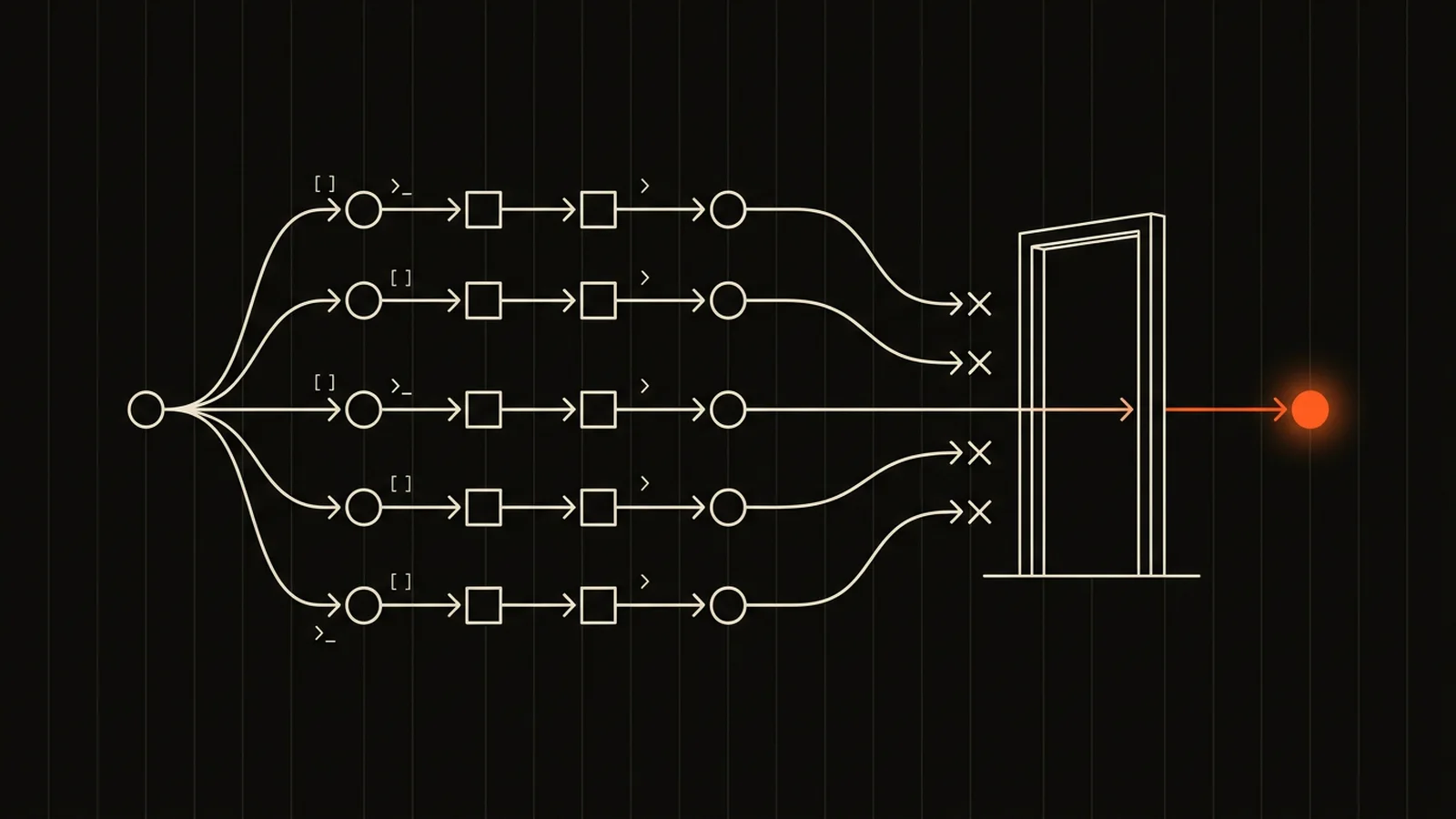
Meridian takes a goal, decomposes it into a dependency graph of tasks, and executes independent tasks in parallel waves through headless coding agents. A live dashboard shows what the swarm is doing at any moment.
Chapter 3 · The hard partThe Friction
Agents are confident narrators. Left alone, a swarm will report success on work that does not compile, and the next wave will build on top of it.
The decision was to trust nothing but exit codes. Every result is verified independently with real shell commands. Each project carries a persistent brain, so later waves receive what earlier waves actually built, and retried tasks are shown the verifier's output so they fix root causes instead of retrying blindly.
“Never trust an agent's self-report. Verify with the machine.”
Chapter 4 · The resultThe Monument
Meridian runs autonomously and escalates to a human only when it stalls. It is a working answer to the question every engineering organisation will face this decade: how do you manage a workforce that never sleeps and occasionally lies?
- Parallel
- Dependency-aware task waves
- Exit codes
- The only accepted proof of success
- Per-project
- Persistent memory across runs